

Look for gluten-free cookies and you will see many different wordings, such as “no wheat flour used” (小麦粉不使用) and “gluten-free” (グルテンフリー). This guide sorts out where to look on the label to tell them apart, from three angles: ingredients, oats and where the cookies are made.
In short: “No wheat flour” alone is not enough. Check that there is no wheat, barley or rye in the ingredients, that any oats meet a gluten-free standard, and that wheat is not handled where the cookies are made.
- “No wheat flour” and “gluten-free” are not the same. Look at barley and rye, and at wheat where the cookies are made, too.
- Rice flour, oats and almond flour are common replacements for wheat flour. The texture and what to watch change with each.
- Oats themselves contain no gluten, but wheat can get mixed in on the way from field to factory.
- If you also avoid eggs, dairy or sugar, check the words in the ingredient list.
What to Check First on a “Gluten-Free” Cookie
Even when a cookie is made without wheat flour, wheat can come in through other ingredients or through the place where it is made.
If you are not sure, go through three things in order: the ingredients, the oats and where it is made. The differences become easier to see.
| Where to look | Why | |
|---|---|---|
| Ingredients 原材料 | Wheat (小麦), barley (大麦), rye (ライ麦), and anything listed as malt (麦芽 / モルト) | Grains other than wheat, or sweeteners made from them, may be used |
| Oats オーツ麦 | Whether they meet a gluten-free standard | Wheat can get mixed in on the way from field to factory |
| Where it is made 製造環境 | A dedicated line, or a place that also handles wheat | Traces can get in even when wheat is not an ingredient |
What Replaces the Wheat Flour
Gluten-free cookies are baked with something in place of wheat flour. The texture, and what to watch out for, depend on what that is.
| Texture | Keep in mind | |
|---|---|---|
| Rice flour 米粉 | Light and crisp | Rice flour itself contains no gluten. Check the other ingredients and where it is made as well |
| Oats オーツ麦 | Crunchy, with some bite | Check whether they meet a gluten-free standard |
| Almond flour アーモンドプードル | Moist and nutty | It is a nut. Avoid it if you have a nut allergy |
Texture depends on the recipe. Take this as a rough guide.
When I started working on L for You’s cookies, what surprised me was how much the taste changes with the rice flour. It is a little like tasting a new variety of rice side by side with others and finding them completely different.
The rice flour you choose changes a cookie’s flavor entirely. At L for You, we use a carefully selected rice flour, chosen with our kitchen as the one that brings out the most flavor. For more on rice flour, see What Are Rice Flour Cookies?.
What to Check on Oat Cookies
Oats themselves contain no gluten. But they often pass through the same fields and factories as wheat, and wheat can get mixed in along the way.

If you are choosing oat cookies as gluten-free, check the label, or ask, whether the oats meet the gluten-free standard used in Europe and the US (under 20 ppm). How oats and gluten are related is covered in Is Oatmeal Gluten-Free?.
Is Wheat Handled Where They Are Made?
Even with no wheat in the ingredients, traces can get in (cross-contamination) if wheat is handled in the same kitchen or on the same production line. Whether the pack says it is made on a dedicated line (専用ライン) is one clue.

If you react to trace amounts, check how and where a product is made. Whether it is right for you is your own decision.
If You Also Avoid Eggs, Dairy or Sugar
Strictly, gluten-free means made without wheat and related grains. Yet many people take it to mean no eggs or dairy as well, and honestly, I find this hard to explain.
Many gluten-free cookies are made with eggs or butter. L for You’s cookies use no eggs or dairy, and no refined cane sugar; we sweeten with beet sugar, among others. If there is anything else you avoid, look for these words in the ingredient list.
| On the label | Note | |
|---|---|---|
| Egg | 卵 (egg), 卵白 (egg white), 卵黄 (egg yolk) | Even with “no eggs used” (卵不使用), eggs may be handled where it is made |
| Dairy | バター (butter), 乳製品 (dairy), 脱脂粉乳 (skim milk powder), 乳成分 (milk) | Even with “no dairy used” (乳製品不使用), milk may be handled where it is made |
| Sugar | 砂糖 (sugar), 上白糖 (white sugar), てんさい糖 (beet sugar), ココナッツシュガー (coconut sugar), アガベシロップ (agave syrup) | What sweetens it changes the flavor, too |
What to Check When You Take Them Home
If you are taking cookies home or giving them as a gift, how long they keep matters too. Whether they keep at room temperature, whether they are individually wrapped, and whether preservatives are used all change how long they last.
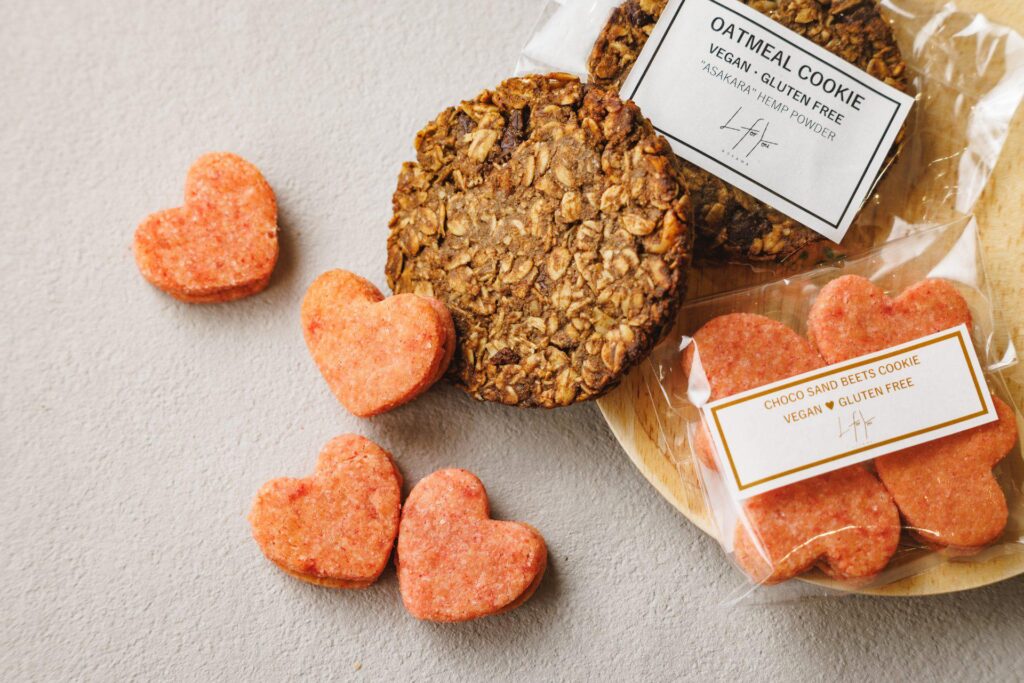
L for You’s cookies are made without wheat flour, eggs or dairy, and all of our baked goods are vegan. Both our beet cookies and our oatmeal cookie use almond flour, and the oatmeal cookie also contains walnuts. They keep at room temperature for about 2 months as a guide, and you can buy them at our shop in Minami-Aoyama.

We don’t use wheat flour, and no wheat is handled in our kitchen. However, we cannot rule out trace contamination that comes from the raw materials themselves — for example, when an ingredient is grown or processed near wheat.
The same applies to eggs and dairy: we don’t use them, but we cannot rule out traces that come from the raw materials themselves. If you have questions about ingredients or allergens, please ask our staff before you buy.
Frequently Asked Questions
Visit Us
| L for You AOYAMA | |
|---|---|
| Address | 1F Ikegami Bldg, 3-9-3 Minami-Aoyama, Minato-ku, Tokyo |
| Access | 6-minute walk from Omotesando Station, Exit A4 |
| Hours | Mon–Thu 11:00–20:00 / Fri 11:00–21:00 / Sat 9:30–21:00 / Sun 9:30–18:00 |
| Phone | +81-3-6459-2504 |
See how to find us, or browse the menu if you’d like to stay for a meal.