When choosing snacks for your children, have you ever picked up a package that says 無添加 (mutenka, additive-free)? This guide explains what that label tells you under Japan’s labeling rules, and what to check on the back of the package.
Don’t decide on the word “additive-free” alone — read the ingredient list on the back. Ingredients come before the slash (/) and food additives after it, so check what is in the snack, along with what sweetens it and ingredients such as liquor or cocoa.
- Under the Consumer Affairs Agency’s guidelines, a label that just says “additive-free” (無添加) is considered potentially misleading, because it doesn’t say what has not been added.
- Even a label that names what is not used, such as “no preservatives” (保存料不使用), may be on a product that uses other food additives.
- The place to check is the ingredient list on the back of the package. In most cases, ingredients come before the slash (/) and food additives after it.
- What sweetens a snack, liquor and ingredients that contain caffeine can also be checked on the ingredient list.
What Does an “Additive-Free” (無添加) Snack Leave Out?
When you choose snacks for children, the word 無添加 on a package may catch your eye. But this word alone doesn’t tell you what has not been added.
In March 2022, Japan’s Consumer Affairs Agency issued its Guidelines on Labeling the Non-Use of Food Additives (食品添加物の不使用表示に関するガイドライン), and asked businesses to review their labels by the end of March 2024. The table shows examples the guidelines give of wording that can be misleading.
| How the guidelines see it | What to check | |
|---|---|---|
| Just 「無添加」 (additive-free) | Considered potentially misleading, because it doesn't say what has not been added | What is listed after the slash (/) in the ingredient list |
| Naming what is not used, such as 「保存料不使用」 (no preservatives) | Shows that this additive is not used. Saying so while using another additive that does the same job is considered potentially misleading | Whether other additives appear after the slash |
| 「人工甘味料不使用」 (no artificial sweeteners), 「化学調味料無添加」 (no chemical seasonings) | Words such as “artificial” and “chemical” are not used in Japan's food labeling rules, and are considered potentially misleading | How sweeteners and seasonings are written after the slash |
| “Additive-free, so it's good for you” or “so it's safe” | Presenting the absence of additives as a reason a food is healthy or safe is considered potentially misleading | The ingredient list on the back, not the words on the front |
A general reading based on the Consumer Affairs Agency's Guidelines on Labeling the Non-Use of Food Additives (March 30, 2022). Whether a label breaks the rules is judged product by product, looking at the label as a whole.
The guidelines don’t ban “additive-free” or “not used” labels. Use the words on the front as a starting point, and check what is actually in the snack on the back. For the order to check the back of a bag at a convenience store, see Additive-Free (無添加) Snacks at Japanese Convenience Stores.
Read Before and After the Slash (/)
Whether or not a package says “additive-free,” the place to check is the same. In the ingredient list on the back, ingredients usually come first, from the largest amount down, then a slash (/), then food additives.
| Where it is written | What to look at | |
|---|---|---|
| Ingredients | Before the slash (/), from the largest amount down | What comes first |
| Food additives | After the slash | What is listed, and how many |
| Allergy-related ingredients | 「(一部に○○を含む)」 (contains, in part, …) after the ingredients, or 「(○○を含む)」 (contains …) after each ingredient | Whether anything your child avoids is there |
| Nutrition facts (栄養成分表示) | A separate box from the ingredient list | Calories and carbohydrates. Sugars may not be listed |
A line break or a separate box may be used instead of a slash. For each product, its own package is what counts.
For more on reading the ingredient box on a Japanese package, see How to Read Japanese Food Labels for Wheat and Gluten.
Check What Sweetens It, Liquor and Caffeine on the Ingredient List Too
For children’s snacks, there may be other things you want to check besides additives. What sweetens a snack, liquor and ingredients that contain caffeine are all written in the ingredient list. For types of sugar and how labels such as 砂糖不使用 and ノンシュガー differ, see Sweets Without Refined Sugar.
| How it may be written | What to look at | |
|---|---|---|
| What sweetens it | 砂糖 (sugar), てんさい糖 (beet sugar), きび糖 (cane sugar), メープルシロップ (maple syrup), fruit | What it is sweetened with, and where it comes in the list |
| Sweeteners | 甘味料(ステビア)(sweetener: stevia) and so on, after the slash | A package labeled 砂糖不使用 (no sugar used) may still contain sweeteners |
| Liquor | ラム酒 (rum), ブランデー (brandy), 洋酒 (liquor) | Sometimes used in baked goods and cakes |
| Ingredients that contain caffeine | ココア (cocoa), チョコレート (chocolate), 紅茶 (black tea), 抹茶 (matcha), コーヒー (coffee) | May be in chocolate, black tea or matcha-flavored sweets |
What to avoid differs from family to family. Please check the ingredient list before you choose.
L for You Baked Goods: Ingredients by Flavor
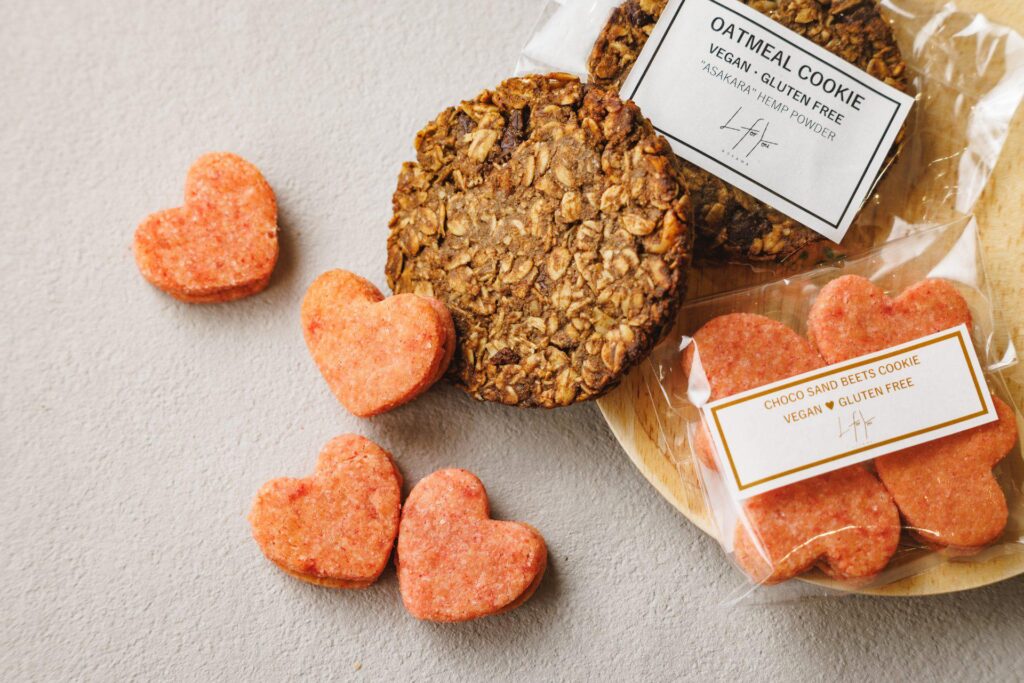
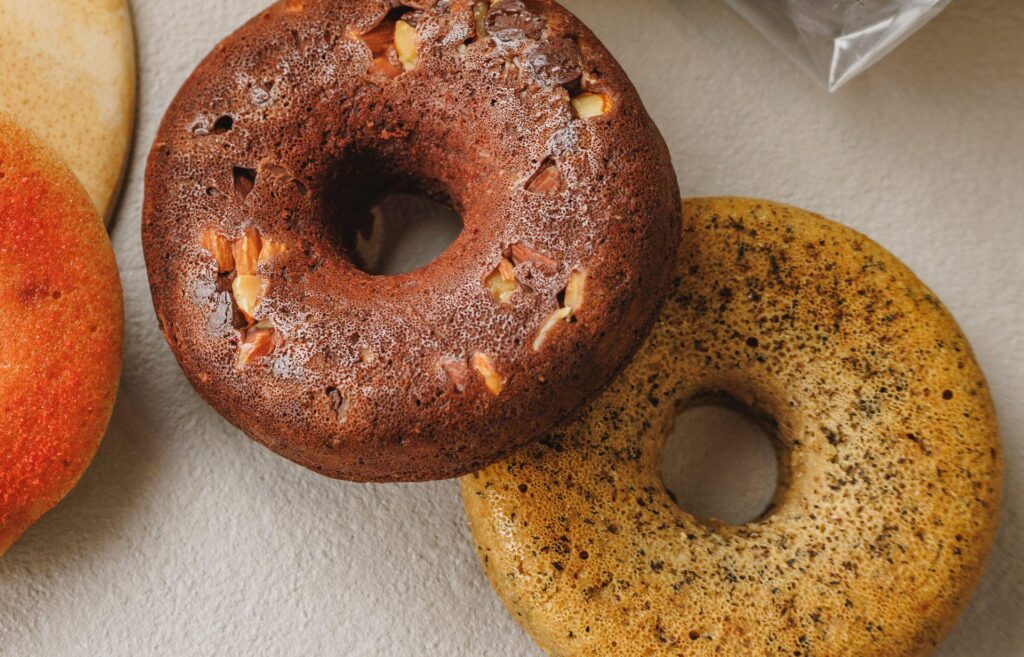
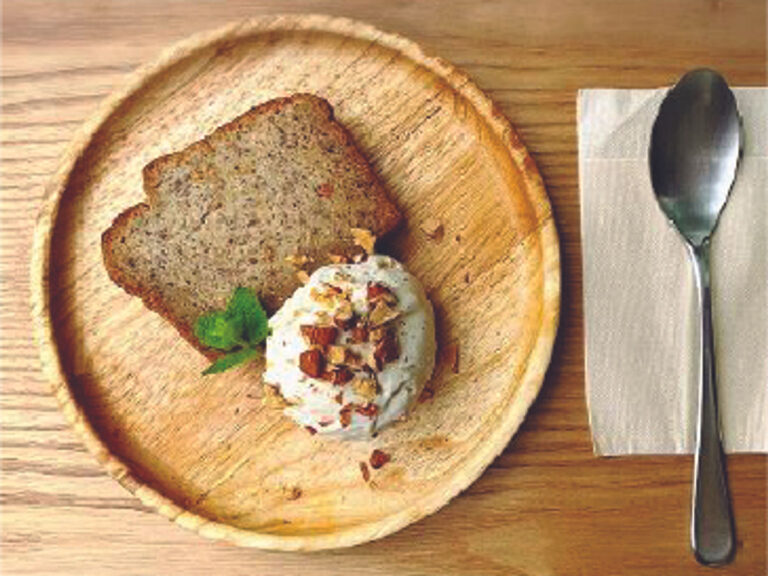
All our baked goods are vegan and made without wheat flour or refined cane sugar (white sugar). We sweeten them with beet sugar, among others. This table shows, flavor by flavor, whether we use liquor, ingredients that contain caffeine, or nuts.
| Liquor or ingredients containing caffeine | Nuts | |
|---|---|---|
| Donut: strawberry | None | Almond flour |
| Donut: chocolate chip & almond | Cocoa, chocolate | Almonds, almond flour |
| Donut: Earl Grey, raisin & mulberry | Black tea (Earl Grey) | Almond flour |
| Pound cake: chlorella & azuki bean | None | Almond flour |
| Pound cake: banana | Rum | None |
| Pound cake: chocolate-chip banana | Rum, chocolate chips | None |
| Pound cake: dried fig & walnut cocoa | Rum, cocoa | Walnuts, almond flour |
| Chocolate sandwich beet cookies | Chocolate | Almond flour |
| Oatmeal cookie (chocolate chip & walnut) | Chocolate | Walnuts, almond flour |
| Apple tart | Rum | Almond flour |
Based on our ingredients as of October 26, 2026. Flavors at the shop change from day to day. Even in items made without nuts, we cannot rule out trace contamination that comes from the raw materials.

Cookies, donuts and pound cakes are always available at our shop in Minami-Aoyama. Flavors change from day to day, so please ask our staff what is on the shelf and about the ingredients of each item.
We don’t use wheat flour, and no wheat is handled in our kitchen. However, we cannot rule out trace contamination that comes from the raw materials themselves — for example, when an ingredient is grown or processed near wheat. Some items contain nuts such as walnuts and almonds.
Frequently Asked Questions
Visit Us
| L for You AOYAMA | |
|---|---|
| Address | 1F Ikegami Bldg, 3-9-3 Minami-Aoyama, Minato-ku, Tokyo |
| Access | 6-minute walk from Omotesando Station, Exit A4 |
| Hours | Mon–Thu 11:00–20:00 / Fri 11:00–21:00 / Sat 9:30–21:00 / Sun 9:30–18:00 |
| Phone | +81-3-6459-2504 |
See access and opening hours and our menu, or read why families choose L for You.